


Client: St. Alphonsus Regional Medical Center
Location: Boise, Idaho
Project Type: Helipad recoating and traction upgrade
Completed: August 2025
Background
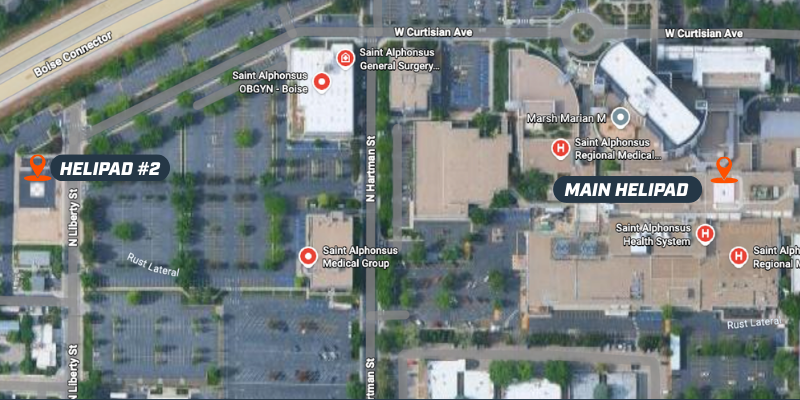
St. Alphonsus Regional Medical Center relies on its primary rooftop helipad for fast, direct access to the Emergency Room. Although there is a secondary helipad on the far side of the campus, using it requires transferring patients from the helicopter to an ambulance and then across campus to the ER. In time-critical situations, that extra step is a serious disadvantage.
For years, the hospital's internal maintenance crews tried to keep the primary helipad operational by rolling on new coats of big-box-store coating products. Because the pad could not be out of service for long, these quick fixes were applied over existing layers with minimal surface preparation. Each new coat failed to bond properly and eventually began peeling away in sheets.
By 2025, the helipad surface had multiple layers of failing coatings. Chunks of material were flaking off across the diamond plate metal, creating trip hazards for emergency crews and signaling that the "band-aid" approach was no longer acceptable.
The Challenge
St. Alphonsus needed a solution that checked three critical boxes:
- Fast return to service: The primary helipad could not be out of operation for more than a few days.
- Long-term durability: The hospital wanted to end the cycle of yearly peeling and recoating.
- Improved safety: Loose, flaking coatings needed to be eliminated so crews could move quickly and safely during landings and patient transfers.
There were also logistical constraints. Heavy equipment had to meet the requirements of the elevators to the helipad. At the same time, surface preparation still had to be thorough enough to ensure a sound substrate and good adhesion for the new system.
The Solution
Roe Painting designed a coating system and process that balanced project time, safety, and long-term performance.
1. Surface Preparation
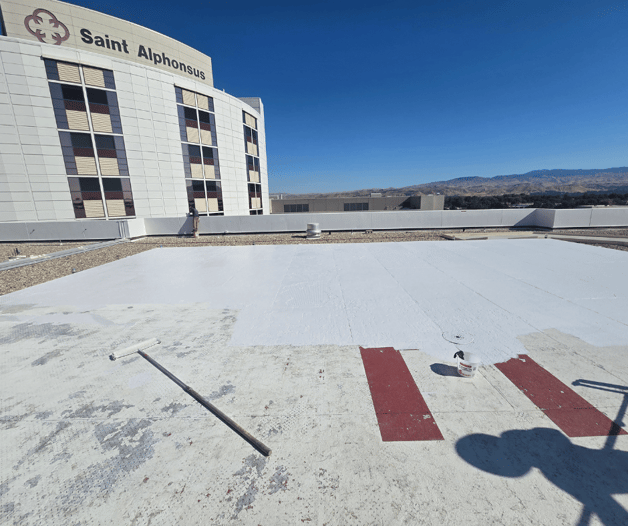
The crew focused on removing all loose and poorly bonded material while staying within the hospital's downtime window.
- High-pressure washing and scraping were used to lift and remove flaking coatings.
- All loose layers were taken off to expose a sound, stable surface suitable for new coatings.
- Full stripping to bare metal was not feasible within the time and access constraints, so the team concentrated on achieving a clean, well-prepared substrate for long-term adhesion.
2. Multi-Layer Coating System
Once the surface was properly prepared, Roe installed a multi-coat system designed for aviation and exterior metal surfaces:
- Primer: Gulf Coast CM-15 Build Epoxy Primer applied to bond to the prepared metal and remaining sound coatings.
- Traction Additive: Heavy broadcast of 36-grit aluminum oxide into the primer to create an aggressive texture for wet and icy conditions.
- Intermediate Coat: Additional coat of Gulf Coast CM-15 High Build Epoxy Primer for build and encapsulation of the aggregate.
- Topcoat: Gulf-Thane CT-352 High Gloss Polyester Polyurethane Enamel applied as the final finish, selected for its UV resistance, chemical resistance, and durability under helicopter traffic.
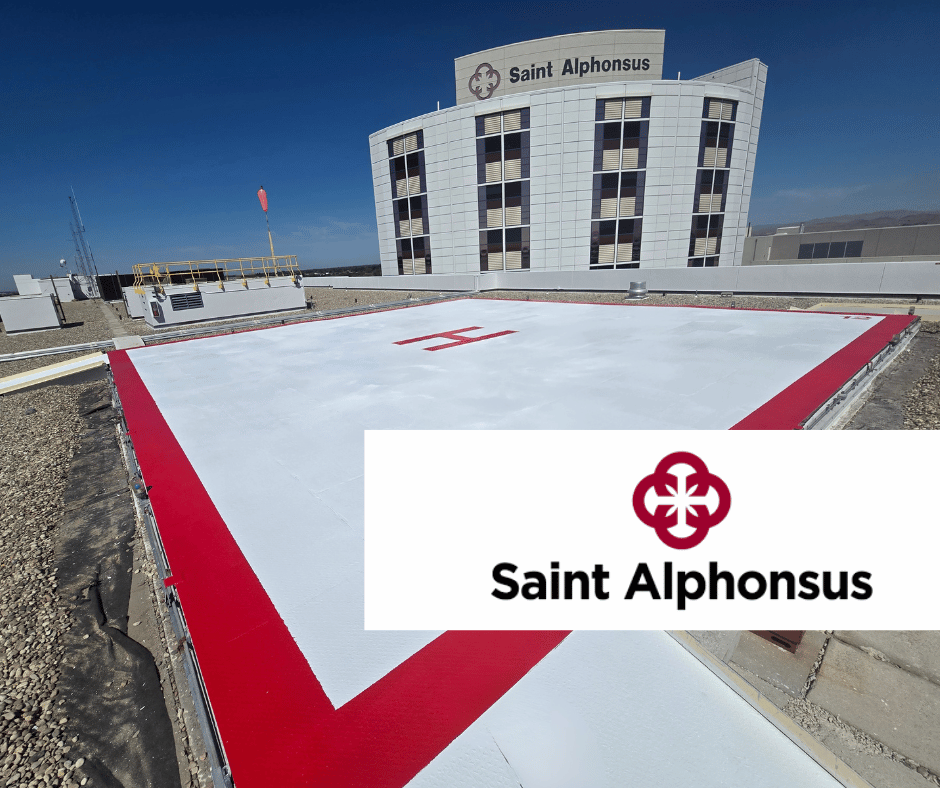
.png?width=671&height=563&name=st%20alphonsus%20helipad%20coating%20in%20boise%20idaho%20by%20roe%20painting%20(1).png)
3. Safety Markings and Layout
Emergency crews rely on clear, consistent markings for safe landings. Roe Painting:
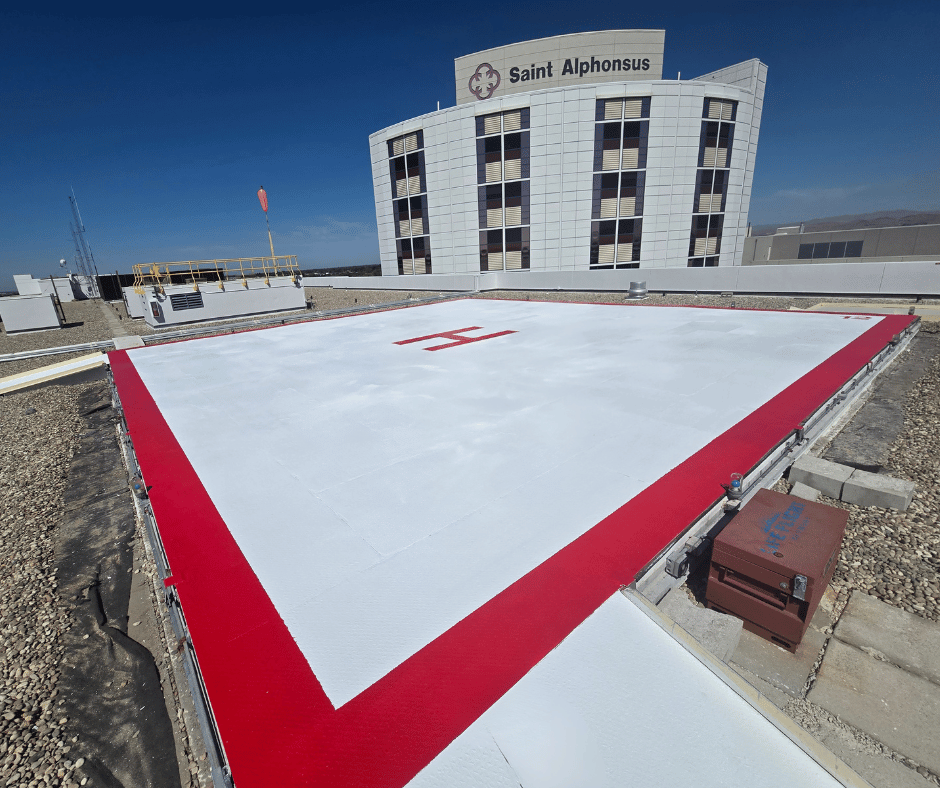
- Carefully measured and documented the existing red border and red "H."
- Reapplied direction markings to closely match the original size and location.
.jpg?width=4000&height=3000&name=20250815_115124%20(1).jpg)
Project Timeline and Execution
The project was scheduled during normal business hours with the understanding that:
- The helipad would be shut down for the duration of preparation, coating, and cure time.
- The coating could not be walked on for 24 hours and would reach full cure for equipment use at approximately 48 hours.
- In the event of a true emergency, the hospital retained the option to use the pad before full cure, with the understanding that any damage caused would require additional repair.
Roe Painting's crew pushed to keep the project under seven days, including preparation, coatings, markings, and cleanup. The work was completed within that window, and the helipad was returned to service on schedule.
Results
The new helipad coating system delivered the long-term, safety-focused solution St. Alphonsus needed:
- Reliable access to the primary helipad: The pad was returned to service in less than seven days, maintaining the hospital’s ability to move critical patients directly from helicopter to ER.
- Expected service life of 8 to 10 years: The epoxy and polyurethane system is designed to break the cycle of annual flaking and repainting.
- Improved traction for emergency crews: The heavy 36-grit aluminum oxide broadcast provides a textured surface that performs better in wet and icy conditions, while still allowing the hospital to use ice melt products as needed.
- Reduced burden on internal maintenance teams: Instead of rolling on a temporary coating every year, the hospital now has a long-term system that protects the helipad and frees up maintenance crews to focus on other priorities.
- Consistent visual markings: The red border and “H” were relaid with precision, maintaining safe, familiar visual reference points for pilots and landing crews.
Post-project, the helipad has continued to perform well, with no complaints from the hospital. The new system provides a durable, high-traction surface that supports the mission-critical work happening at St. Alphonsus every day.
Why It Matters for Hospitals and Medical Facilities
For hospitals that rely on helipads and high-traffic exterior surfaces, quick fixes and cheap coatings can become a recurring source of risk and cost. This project at St. Alphonsus shows how investing in the right coating system can:
- Protect critical patient access routes
- Improve safety for emergency staff and crews
- Reduce recurring maintenance and unplanned downtime
- Deliver performance that holds up year after year
wer
When the stakes include minutes of response time and the safety of patients and staff, a helipad coating is more than a cosmetic decision. It is an operational and clinical one.
For a complimentary visit or assessment of your medical facility, and how our painting and coating solutions can help you protect assets and reduce operational costs, request a quote.
Topics: